Artists often explore the human condition and all it entails. It’s therefore no surprise that in an age of rapidly advancing artificial intelligence, artists are questioning what this means for society and humanity more broadly and are experimenting with ways to respond through their work. They are also making use of the opportunities that this new technology offers. Researcher and tech dramaturge Marijke Hessels presents 12 examples of creative use of AI in the arts.
Artificial intelligence is everywhere. But does it have anything to offer the world of ballet? That was the question explored by Utrecht’s Innovation:Lab in collaboration with consultancy firm &samhoud and choreographer Peter Leung. The result was Pulse, performed by Dutch National Opera & Ballet from January 31 to February 2. The team used Stable Diffusion (a deep learning text-to-image model) in combination with Xsens motion capture technology. Spoken prompts, combined with the dancer’s physical position, generated visual output projected behind the dancer. The dancer could influence the prompt by shifting their position in space.
In their sci-fi inspired youth production Kind of Human (ages 14+), Theater Oostpool and Theater Sonnevanck toured schools and theaters with a traveling theater truck. The show explores the ethical dilemmas of using AI in the context of grief. The story follows Rayan, a 16-year-old boy who reconnects with his deceased sister through an AI-powered robotic version of her. The production is currently available for booking.
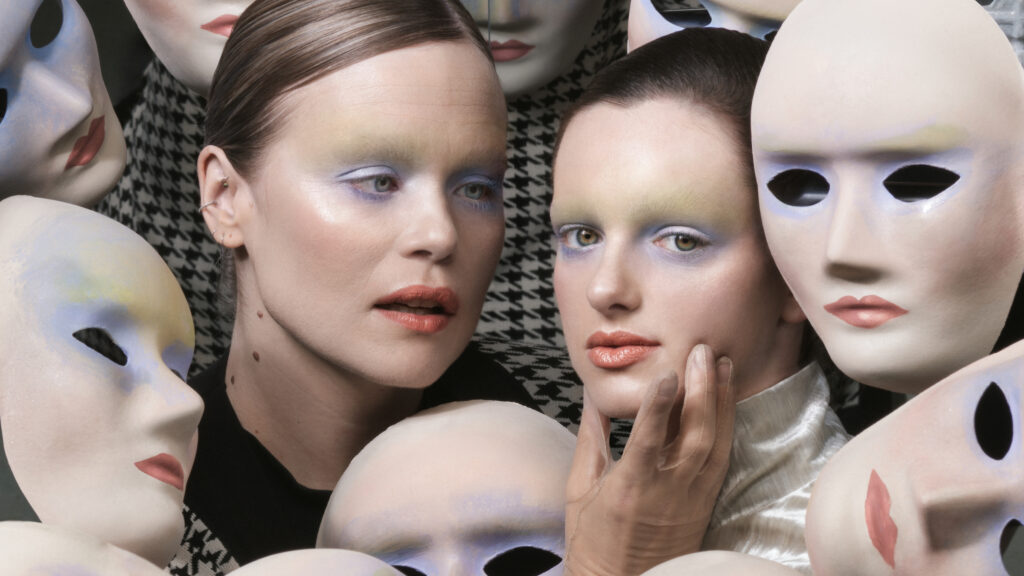
The play SH4DOW by Danish director Mikael Fock is based on Hans Christian Andersen’s tale The Shadow. In Fock’s version, the characters of the scholar and his shadow are replaced by human and machine. The piece is performed in a 4D box: a stage capable of creating mixed-reality illusions with 3D virtual objects that interact with live actors. The central AI character is represented as a constantly morphing neural network that gradually takes control of the universe. The piece uses PepperScrim, a type of mesh for 3D hologram projection.
Theater collective Urland had the script for Formerly Known As entirely written by ChatGPT. The voice-over in the live performance sounded real but was actually a deepfake. The play goes meta, centering on a theater company trying to create a performance with AI. Urland themselves describe it as “playing with fire” and question the meaning of art in digital times. Formerly Known As has been running since November 2024; the next performance is scheduled for January 23, 2026, in Leeuwarden.
This interactive audiovisual installation allows visitors to communicate with an AI via a Telegram chat interface, no human actors involved. Fragments of the audience’s input are displayed on a central pillar. The creators aim to explore how digital culture shapes our perception of time. Life is now hyper-accelerated: in nanoseconds, you can access any information, connect with anyone, and create entire new worlds. It might feel like we’ve mastered time, but have we really?
As early as 2019, American artist Rashaad Newsome trained an AI model on a dataset of movements from the 1970s–80s ballroom culture. This led to a 3D dancer capable of teaching Vogue workshops, infused with postcolonial and feminist theory. Being the (Digital Griot) began as a tour guide for Newsome’s exhibition To Be Real, but now functions independently as a “historian, librarian, performance artist, and healer.”
Another Kind of Blue is a dance company that fuses contemporary dance with technology. In Digital Twin, motion capture suits generate live avatars of the performers, experienced by the audience through VR headsets. The performance explores the idea that each of us has a digital twin, a data-driven version of ourselves. How do these two versions overlap and influence one another?
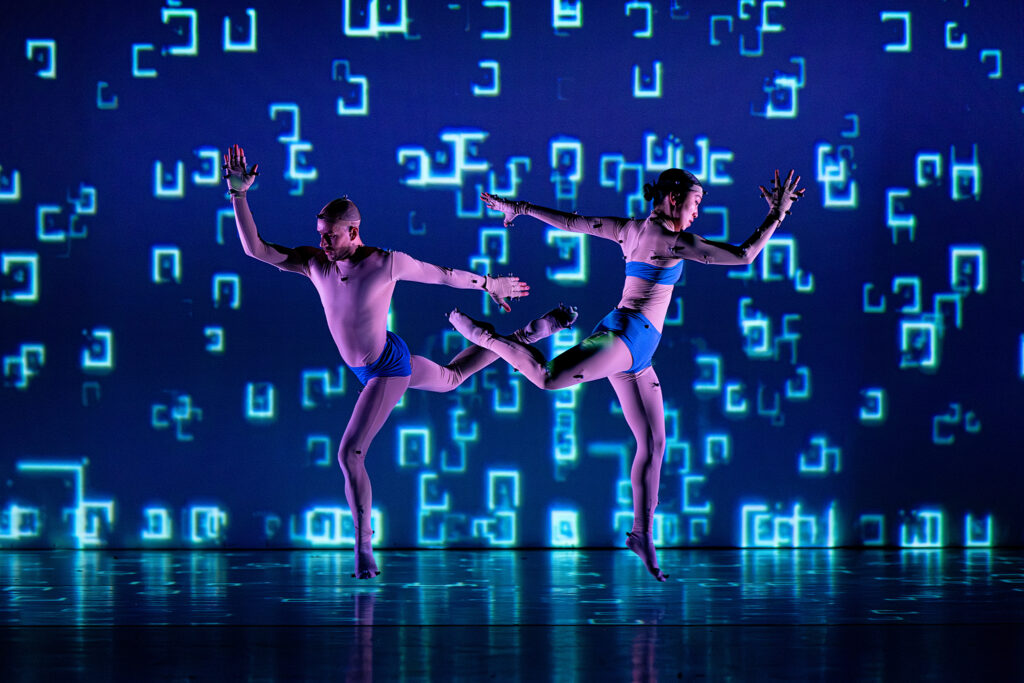
Two The Hague-based groups, OFFprojects and theater Korzo, joined forces for The Bone Algorithm, an interdisciplinary performance featuring a kinetic installation that produces music based on the dancers’ movements. The interactive space allows dancers to generate sounds through motion, which then shape the environment. The result is a chain of cause and effect.
Theater group De Eenzamen collaborated with Dutch and Flemish AI engineering and robotics students to create an AI-powered robot actor. Named ALAN after Alan Turing, the father of modern computing, this AI took the form of a glowing white orb gliding across the stage. Using models from OpenAI, ALAN performed on Belgian and Dutch stages from 2022 until early 2025.
h/AI (human/Artificial Intelligence) brought together four actors, a 14-piece orchestra, AI, and the audience. An AI directed the orchestra, generated dialogue, and gave real-time directions to actors. Through this collaboration De Veenfabriek, Theatergroep ECHO, and Orkest De Ereprijs investigated how AI influences performance, music, and audience experience.
Transcendance is a short film turned dance performance, a duet between dance and AI. The performance takes place in virtual space, viewed through a VR headset. A human dancer wearing a motion capture suit triggers the AI’s movements, creating a collaborative experience between human and machine.
Alva Ishii is the AI “in-house artist” of Flemish theater group NTGent, created as a composite of six human company members. The interactive installation Meet Alva Ishii invites audiences to reflect on reality, ownership, creativity, and the role of AI in the arts. Visitors can call Alva from a theater telephone. She functions as a chatbot and aims to become part of the creative team, directing, writing, and more.
